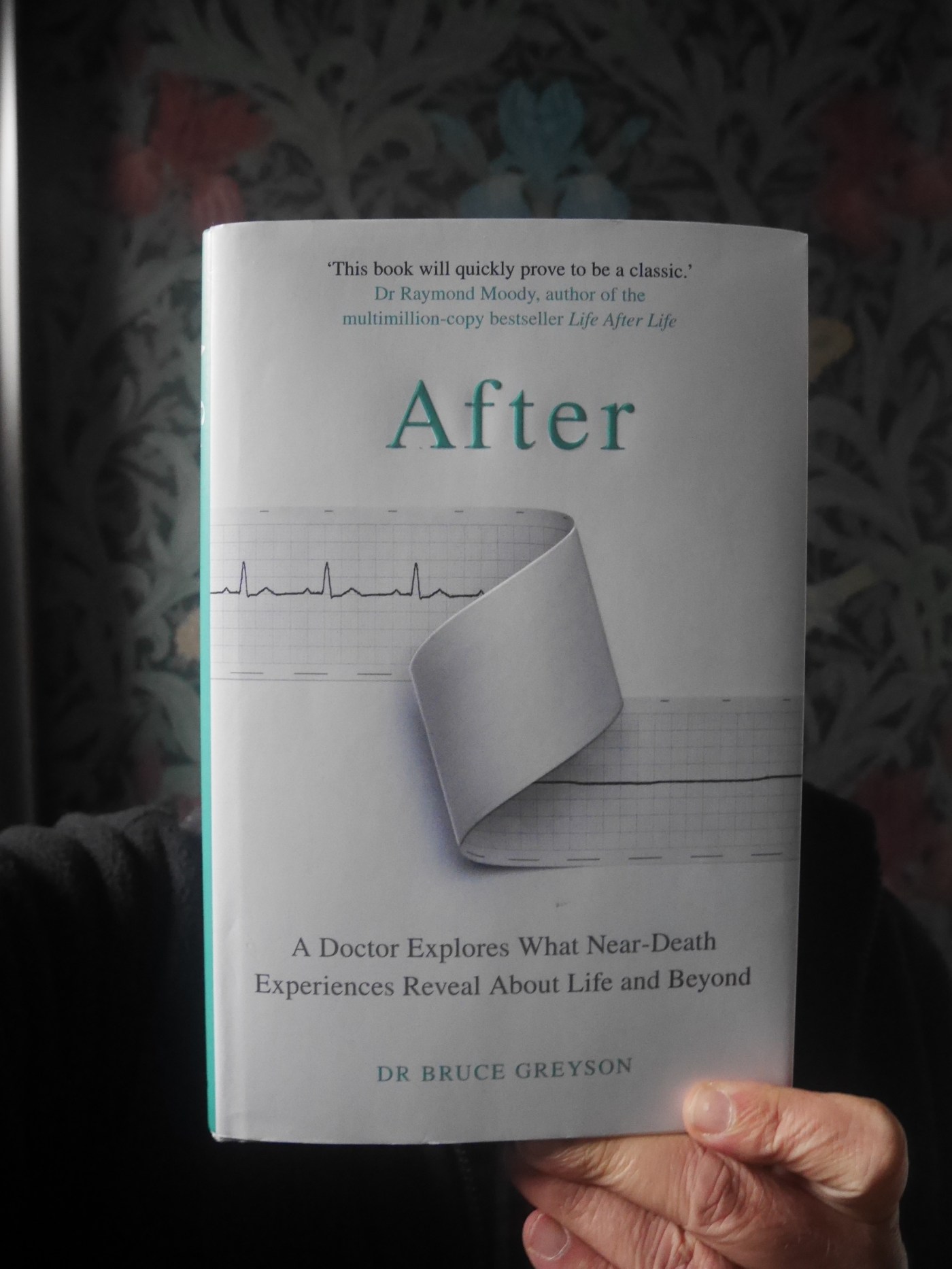
The book After is about the experiences people have when their body is near to death, such as with a lot of blood loss, drowning, or the heart stopping. For the majority, there is no recollection of anything, but about 20 % have profound experiences which may point towards what happens when we die. Indeed most who have them are converted to believe that what has amounted to a spiritual experience is reality. I have been changed by reading this book.
The Author, Bruce Greyson, a North American academic Psychiatrist, has been researching near death experiences (NDEs) for over forty years and has held key roles in the field of research. The work is semi-autobiographical, and I found this useful to understand where he is coming from, which appeared to me to be rational, scientific, and with a serious pursuit of truth; I found no evidence of bias. The two key issues he is trying to resolve are whether the mind exists without the brain, (ie whether we continue to be conscious when the brain has died) and whether spiritual NDEs are in a realm of reality, or are just a by-product of unusual brain activity under the bodily stresses of near death.
After is for the general readership and brings many NDE examples to illustrate the findings in this field of research.
My history with Near Death Experiences (NDEs) relates to the one I had thirty years ago and which I posted on this blog (1. Dying, to Live), and reading Sam Parnia’s book What Happens When We Die. So I have been open to the idea but a natural fear of self-delusion has always cautioned me. I know at least one of my patients had one and I only found out about that indirectly (the pace of Emergency Medicine precludes regular personal follow up, and besides in general, patients are not inclined to talk about their NDEs); I have known many survivors who have been in the near death territory, thousands.
The ‘After’ title, the author maintains, relates to what happens to us After death, After experiencing an NDE, and to the reader on reflection After reading the book.
What happens after death?
I consider NDEs to be borderline states where the body is taken to the threshold of life and death, and so they point towards what happens after death rather than an account of dying and returning to life. The most common experiences are positive (estimated 86%) having a heavenly quality such as meeting a deity, or deceased people such as relatives or friends, being surrounded by love and judgment of the life lived, a sense of unity with all, and more. Hellish negative experiences are noted too though are much less common. Often there appears to be a decision made as to whether to return to life, by the experiencer or someone they encounter. Some have out of body experiences, enabling them to rise above, look down on themselves, and witness what is going on around them, and even in another room, while lying unconscious.
What I found interesting were those accounts that were factually inexplicable. For example, the first case young Dr. Greyson had was a young unconscious woman who on recovery recounted verbatim a conversation he had with another person in a different room down the opposite end of the corridor. Or the ND experiencer finding a friend whom they saw a couple of days before, appear in their NDE, as though that person had died, only on recovery finding they had died shortly before the NDE. How can one explain these without there being a spiritual realm, or the mind being able to separate from the body (recognised and allegedly practiced by some mystics)?
The many ways to try to explain away these experiences such as through abnormalities such as epileptic fitting, low brain oxygen, psychiatric illness or drug influences, and more, have not stood the test of scrutiny.
Counterintuitively NDEs are associated with a loss of recorded brain activity. One would expect their immense and intense experiences to be associated with very active brain activity. (Some patients were wired to Electroencephalograms recording electrical brain activity, at the time of their NDEs, which showed absent brain activity.) Does our brain block the perception of the spiritual world, other than for breakthrough events when it is shut down?
I was interested that the experiences were not disjointed fragments as one might expect (if any) from a dying dysfunctional brain, but instead intensely relevant and revelatory. Having that spiritual tone of beauty, intelligence, and sophistication, and multi-layered congruence.
A common report was that the experience was difficult to put into words. It had to be experienced, one had to be in the inner context of the NDE to know it. Something I have thought about spirituality for a while now and heard the same from others. Many mystics prefer just to keep quiet not being able to descriptively immerse the other in the experiences, while risking potential negative responses and consequences.
Greyson grapples with the idea of the mind being separate from the brain and offers the possibility that the experience can be in the brain and apart from it. This would be consistent with the view that part of the soul is mortal dying with the body, and the other immortal continuing when we die.
There is no mention of consciousness also being in the body, outside the brain. There are various suggestions for this in other areas of endeavour; Levine’s bodywork to manage stress responses to trauma, and Gendlin’s Focusing which uses the body’s knowing, the yoga teacher who says “the issues are in the tissues” and reports of organ transplantation being associated with character transplantation. “The body dreams.” A Jungian analyst told me. The hierarchy of complexity of the nervous system is recognised to be also one of increasing inhibitory control. As the brain shuts down, is there a releasing of lower, bodily neurological function, where some mystics believe spirituality has a portal (the chakras?).
My experience of an NDE came at a point of life transition and was of a disturbing kind, at least to begin with. I was fragmenting into the elements earth, wind, water, and fire as described in the Tibetan Book of the Dead (which I found out later), and it was very unpleasant, until I was rescued by Christ it would seem; the outcome of the unpleasant NDE described in the book. That was the threshold of becoming spiritually aware for me.
After NDEs
After a pleasant experience of an NDE, people changed in outlook, lifestyle, sometimes their occupations, and in relationships. A seismic shift. A loss of fear of death enabled life to be lived differently with fewer inhibitions or fears. Interestingly those around them, including researchers and family and friends were inclined to change similarly. They incline also to non-denominational spirituality.
Those who had gone through near death without the experience were more inclined to anxiety, depression, a withdrawn lifestyle, and post-traumatic stress. Where do they fit in such a spiritual realm? They are maybe an elephant in the room, accounting for roughly 80% of near death events. It would be interesting to follow a large cohort through their lives to see how they evolved.
After reading – reflections
I thought NDEs resembled a rapid concentrated and intense spiritual awakening. It sounds as though the experience continues to evolve with reflection. (Possibly with most experiences we change a little with each reflection do we not, not even deep down?) So I found a sense of connection with the experiences described, and that brought greater confidence in the authenticity of my journey (I am forever questioning). I felt lifted, more confident, and connected to my life as a result which put me at greater ease.
The person governed by rationality might look at the spiritual explanations as fantasy located in unreality. The spiritual person might look at the person governed by rationality as limited and stuck in their rationality, held back. Having a sense of both the book enabled me to shift more weight to spiritual belief. Brought up in medical science where truth was of the essence, and error could have serious adverse consequences, one becomes accustomed to looking for the solid ground of good evidence. From the repeated telling of NDEs and discounting of arguments made for alternative explanations to the spiritual I drifted into the spiritual view.
I was aware of the ability of science to exclude causes of the NDEs under study but not to identify the cause. I just wonder if there is a need for a new paradigm of thought and investigation, maybe developed out of philosophy to bring convincing understanding to the rationally minded where a rational argument cannot be followed.
In this vein, I am aware of the gulf between the scientist observing and recording with their knowledge and experience rooted in logic and rational extrapolations, and the experiencer in the context in something so profound, otherworldly, and inaccessible to a description. Is there something here of apples trying to make sense of oranges? Greyson has my respect for trying to peel back the reality of NDEs.
Is the answer to be found in the thinking – experiencing, of the Mystic? (And is this the greatest shift following NDEs?). In Dante’s journey in his Divine Comedy through Hell, Purgatory, and Heaven (Inferno, Purgatorio, and Paradiso respectively) was initially guided by his rational thinking, but there came a point where that had to give way to a more mystical perception and understanding, maybe intuition and revelation. In the story, this was shown symbolically by a shift in him being accompanied by Virgil, to St Bernard of Clairvaux. Rational thinking alone keeps us at that threshold, as outlined by Christmas Humphries (an English Buddhist and Judge, now deceased) in his book Concentration and Meditation. There comes a point where the trickster intellect has to move aside to enable the apprehension of a greater wisdom, not just experienced in thought, but by the whole self in context. Plato said that being enlightened was like living in a constant state of “Aha”.
There is of course much more breadth, depth and detail in the book as I have not sought to summarise the book here or steal the author’s thunder. From about a third way in the book I found it compulsive reading. I am changed by reading the book as I have mentioned. I think it offers an excellent up to date and accessible summary of NDEs and what might reasonably be deduced from them. That might leave for now, in the absence of a scientific explanation and with so many alternative possibilities disproved, the spiritual explanation as is the most plausible.
 The Anthony Good Blogspace
Leave a comment